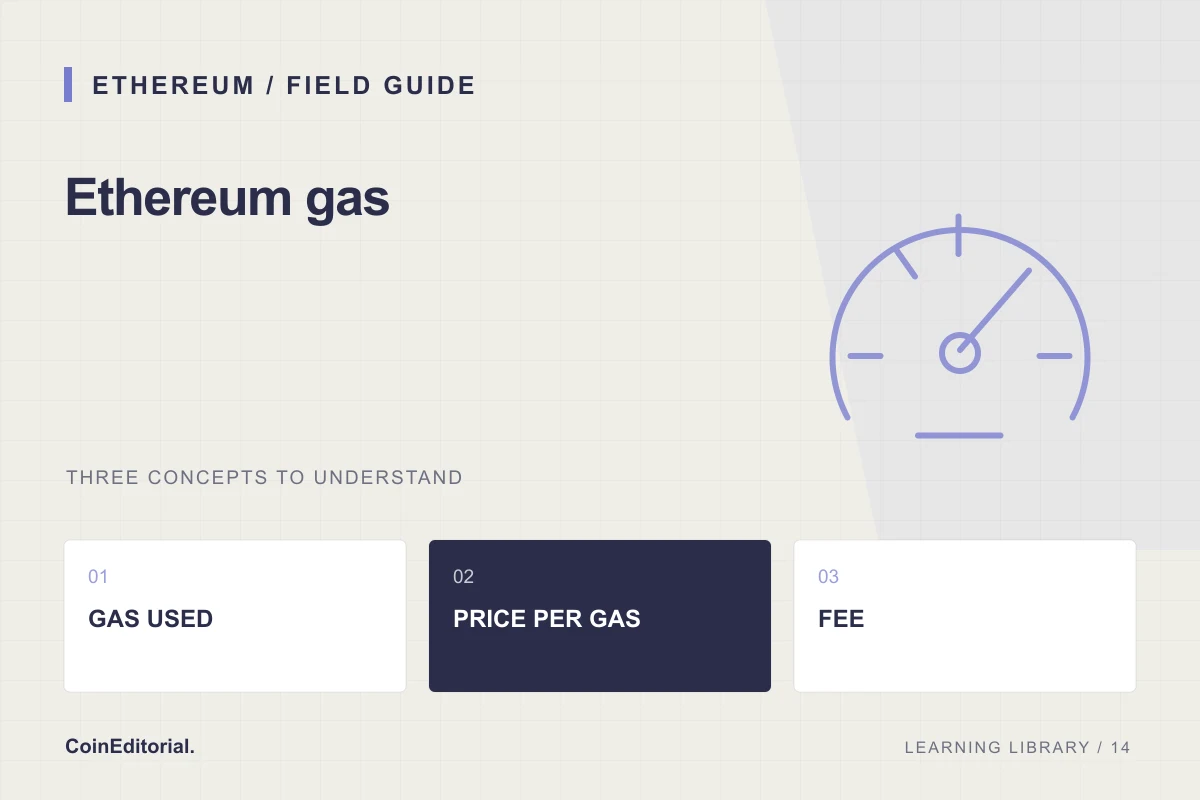
Gas measures execution work; a gas price determines how that work is charged.
Three numbers with different jobs
Ethereum gas accounts for computational work. The base fee is set by the protocol, while a priority fee can compensate the block proposer. A transaction can specify a maximum fee per gas and a gas limit. Those ceilings are not the same as the final amount consumed. Ethereum’s documentation distinguishes the execution budget from the price paid for each unit.
Calculate an illustrative fee
If a hypothetical transaction consumes 50,000 gas at an effective price of 10 gwei, its execution fee is 500,000 gwei, or 0.0005 ETH. Converting that to a currency requires an ETH price at a stated time. The example is arithmetic, not a current quote. Layer-2 transactions can introduce additional fee components, so the same calculation should not be assumed to cover every network.
Why failure still needs investigation
A transaction can consume resources before reverting. The requested application action may fail even though a network fee is charged. Raising the gas limit is not a universal remedy for an expired quote, a failed permission check or inadequate funds. Read the error and simulation result before resubmitting. A wallet’s “submitted” state should not be confused with successful execution.
Review the complete transaction
Identify the network, destination, action, value transferred and fee estimate. If a contract interaction is unfamiliar, understand it before signing rather than judging safety from a small fee. For record keeping, save the transaction hash and actual gas used after completion. This makes later reconciliation possible without relying on the initial estimate or a screenshot whose currency conversion may have changed.
Sources & further reading
Sources checked 7 October 2026. Source-linked explanatory content; not personalised investment advice. Found an error? Request a correction.